
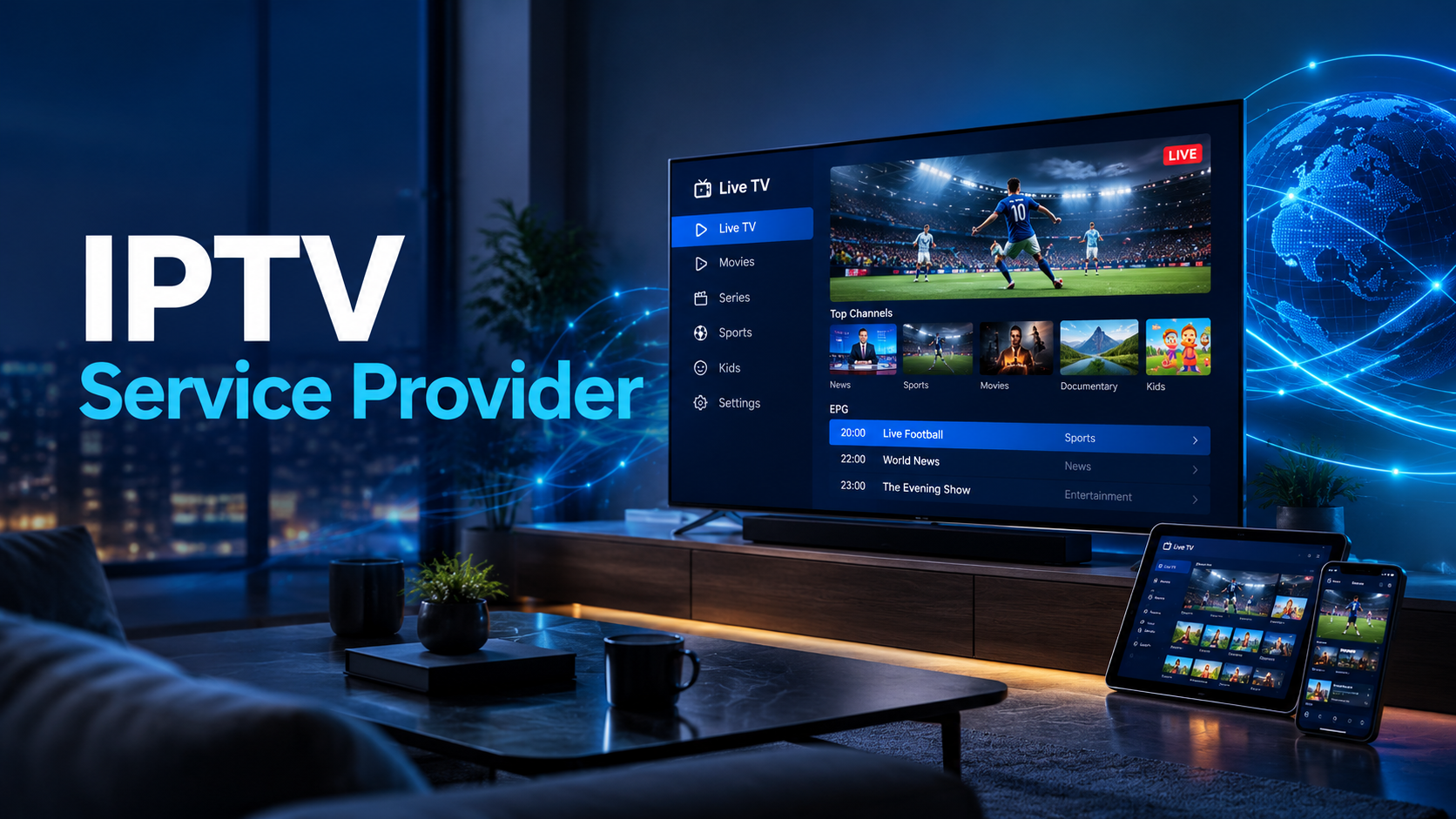
IPTV Service Provider : How to Choose the Right IPTV Service in 2026
Choosing an IPTV service provider can be confusing, especially when dozens of services promise thousands of channels, premium sports, movies, and affordable subscriptions. The right provider should offer reliable streaming, compatible apps, useful features, transparent pricing, and legally licensed content.
Quick answer: An IPTV service provider delivers television programming over an internet connection instead of relying exclusively on traditional cable, satellite, or terrestrial broadcasting. Before subscribing, compare content availability, streaming quality, device compatibility, customer support, pricing, and—most importantly—the provider’s legal rights to distribute its content.
Whether you’re new to IPTV or looking to replace your current television package, this guide explains what to look for and how to make an informed decision.
What Is an IPTV Service Provider?
An IPTV service provider is a company or platform that delivers television content through Internet Protocol (IP) networks. Instead of receiving television signals exclusively through a satellite dish, cable connection, or antenna, IPTV sends video data through an internet connection.
The technology can support several types of television content, including:
- Live television channels
- On-demand movies and programs
- Catch-up television
- Recorded programming
- Interactive television features
- Electronic program guides (EPGs)
The important distinction is between IPTV technology and the legality of a particular service. IPTV itself is simply a method of delivering video over an IP network. The legality of a provider depends on whether it has the necessary rights and licenses to distribute the content it offers.
For beginners, this distinction is essential. A service advertising an unusually large number of premium channels for an extremely low price deserves additional scrutiny.
Link to related article about how IPTV works
How Does IPTV Work?
When you watch content through an IPTV platform, the video is delivered through your internet connection to a compatible device.
The basic process looks like this:
- The provider obtains and hosts authorized television content.
- The content is prepared for internet delivery.
- Video is transmitted through IP networks.
- Your IPTV application receives the stream.
- Your television, smartphone, computer, or streaming device displays the content.
A reliable IPTV service provider also needs appropriate infrastructure to handle large numbers of simultaneous viewers.
This is why two services offering similar channels can provide completely different experiences. One may stream smoothly during busy periods, while another may suffer from buffering or interruptions.
Your own internet connection also matters. Even the best provider cannot completely eliminate problems caused by an unstable Wi-Fi connection, overloaded home network, or insufficient bandwidth.
IPTV vs. Traditional TV Services
One reason people search for an IPTV service provider is the flexibility that internet television can offer.
Traditional television services typically rely on dedicated distribution systems such as cable or satellite. IPTV uses internet-based delivery, allowing providers to integrate television with modern streaming applications and connected devices.
IPTV
- Internet-based delivery
- Works across compatible connected devices
- Often supports on-demand content
- Can provide interactive features
- Usually requires a stable internet connection
Cable or Satellite TV
- Uses dedicated broadcast infrastructure
- May require specialized equipment
- Often comes with traditional channel packages
- Internet may not be required for the television signal itself
- Availability can depend on location and infrastructure
Neither approach is automatically better for every household. Your choice should depend on your location, internet connection, preferred content, devices, budget, and the availability of legitimate services.
What Makes a Good IPTV Service Provider?
Not every provider offers the same quality. When comparing services, look beyond the number of channels advertised.
A strong IPTV service provider should provide a combination of reliability, usability, transparent pricing, customer support, and properly authorized content.
Here are the most important factors to consider.
1. Content and Channel Selection
Start by checking whether the provider actually offers the channels and programming you watch.
A huge channel list may look impressive, but quantity is not necessarily useful if most channels are irrelevant to you.
Consider:
- Local channels
- International channels
- News
- Entertainment
- Documentaries
- Children’s programming
- Sports
- Movies
- On-demand content
If you primarily watch a specific country’s channels, check whether those channels are officially available in your region.
2. Streaming Quality
Video quality is another major consideration when choosing an IPTV service provider.
Depending on the service and content, you may encounter HD, Full HD, or 4K streams. However, advertised resolution alone does not guarantee a good viewing experience.
Look for information about:
- Stream stability
- Video quality
- Buffering performance
- Server capacity
- Adaptive streaming
- Playback reliability during peak hours
A provider with fewer channels but consistent playback can be more practical than a service promising an enormous catalog with frequent interruptions.
3. Device Compatibility
Before subscribing, check whether the service works with your preferred devices.
Depending on the provider, compatibility may include:
- Smart TVs
- Android TV devices
- Apple devices
- Smartphones
- Tablets
- Computers
- Compatible streaming players
- Web browsers
Some providers require a proprietary application, while others work with approved third-party applications.
Always check the provider’s official compatibility documentation before purchasing.
Link to related article about the best devices for IPTV
IPTV Apps and User Experience
The application you use can significantly affect your experience with an IPTV service provider.
A good application should make it easy to find channels, search for programs, access the electronic program guide, and manage your account.
Useful features can include:
- Electronic Program Guide (EPG)
- Favorites
- Search
- Parental controls
- Multiple profiles
- Recently watched content
- Catch-up functionality
- Subtitles
- Multiple audio tracks
A clean interface is particularly important if several members of a household will use the service.
Internet Speed Requirements for IPTV
Your internet connection is one of the most important factors affecting streaming performance.
The exact requirement varies depending on resolution, compression, device, and streaming technology. As a general principle, higher-quality video requires more bandwidth.
| Video Quality | Typical Consideration |
|---|---|
| SD | Lower bandwidth requirement |
| HD | Moderate bandwidth requirement |
| Full HD | Higher bandwidth requirement |
| 4K | Significantly higher bandwidth requirement |
These are not universal minimum requirements because actual performance depends on the provider, compression technology, network conditions, and other devices using your connection.
For the best experience, use a stable connection rather than focusing exclusively on maximum advertised download speed.
If possible, connect your television or streaming device through Ethernet. A strong 5 GHz Wi-Fi connection can also work well when Ethernet is unavailable.
Link to guide about improving home internet for streaming
How to Check IPTV Service Reliability
Before choosing an IPTV service provider, look for evidence of consistent service rather than relying exclusively on promotional claims.
Check the Provider’s Website
A professional provider should clearly explain:
- Available plans
- Supported devices
- Supported regions
- Features
- Payment terms
- Refund policies
- Customer support
- Terms of service
- Privacy information
A lack of basic company information should make you cautious.
Look for Independent Reviews
Customer reviews can provide useful information about real-world performance.
However, don’t rely on a single review. Look for recurring patterns across multiple independent sources.
Pay attention to comments about:
- Buffering
- Customer service
- Billing
- Subscription cancellation
- Application quality
- Reliability
- Account problems
Link to independent streaming service review guide
Legal IPTV Services: Why Licensing Matters
One of the most important questions to ask any IPTV service provider is whether it has the legal right to distribute the content it offers.
The technology itself is legal. The issue is content distribution.
Legitimate services obtain appropriate rights, licenses, or distribution agreements for the programming they provide. Those rights can vary by country and by type of content.
Be especially cautious when a service promises:
- Every premium channel worldwide
- Extremely expensive sports packages for a tiny price
- Thousands of premium channels for almost nothing
- Content from multiple countries without explaining licensing
- No company information
- Unclear payment practices
An unusually attractive offer can sometimes indicate that the service does not have the necessary rights.
For information about copyright and digital content, consult official resources relevant to your country.
Link to WIPO copyright resources
IPTV for Sports Fans
Sports is one of the biggest reasons consumers investigate an IPTV service provider.
However, sports broadcasting rights are often geographically restricted and can change from one season to another.
Before subscribing, check:
- Which competitions are included
- Which countries have access
- Whether the broadcasts are officially licensed
- Whether matches are live or delayed
- Whether replays are available
- Whether commentary languages are supported
Do not assume that a provider advertising a sports channel automatically has permission to redistribute every event shown on that channel.
For major sports competitions, the safest approach is to check the official broadcaster or rights holder in your country.
Link to official sports broadcasting information
IPTV Pricing: What Should You Expect?
Price is another major factor when comparing an IPTV service provider.
Avoid choosing a service based exclusively on the lowest subscription price.
Instead, compare the total value of the package.
Consider:
- Monthly cost
- Longer-term subscription discounts
- Number of supported devices
- On-demand availability
- Streaming quality
- Customer support
- Cancellation terms
- Refund policy
A transparent provider should clearly explain what you are paying for.
Be careful with services that pressure you into buying a very long subscription before you have tested the platform or understood its terms.
Free Trial vs. Paid Subscription
A legitimate provider may offer a trial or introductory period so customers can evaluate the service.
If a trial is available, use it to test:
- Channel availability
- Video quality
- Playback stability
- Application performance
- EPG functionality
- Device compatibility
- Customer support
- Account management
Testing during the hours when you normally watch television can provide more useful information than testing for only a few minutes during an off-peak period.
Never provide unnecessary personal or financial information to an unfamiliar website simply because it advertises a free trial.
How to Choose the Right IPTV Provider
If you’re still comparing options, use this simple checklist.
IPTV Service Provider Comparison Checklist
Content
- Does it offer the programming you actually watch?
- Is the content legally distributed?
- Are local and international channels available where you live?
Quality
- Does the provider support the resolution you need?
- Is streaming stable?
- Does it perform well during busy periods?
Compatibility
- Does it work with your television or streaming device?
- Is the application easy to use?
- Are updates provided?
Pricing
- Is the pricing transparent?
- Are renewal costs clearly displayed?
- Is there a reasonable cancellation or refund policy?
Support
- Is customer service available?
- Are support channels clearly identified?
- Does the company provide setup documentation?
Security
- Does the website use secure payment methods?
- Is there a privacy policy?
- Does the company explain how customer information is handled?
Common IPTV Mistakes to Avoid
Many beginners make the same mistakes when selecting an IPTV service provider.
Choosing Based Only on Channel Count
More channels do not automatically mean better value.
A smaller package containing the channels you actually watch may be more useful.
Ignoring Licensing
A cheap subscription is not necessarily a good deal if the provider cannot demonstrate that it has the necessary distribution rights.
Buying a Long Subscription Immediately
Start with a shorter commitment when possible. This lets you evaluate reliability, compatibility, and support before committing for a longer period.
Assuming Every IPTV App Is the Provider
An application and a content provider are not necessarily the same thing.
Some applications are simply players that can work with compatible services. Always identify who actually provides and licenses the content.
Ignoring Your Home Network
Streaming problems are not always caused by the provider.
Weak Wi-Fi, network congestion, outdated hardware, and multiple simultaneous downloads can all affect playback.
IPTV Service Provider vs. Streaming Platforms
Modern viewers have more choices than traditional television alone.
A typical household may combine:
- Live television
- Subscription streaming platforms
- Free ad-supported streaming
- On-demand services
- Network-specific applications
- IPTV services
The right combination depends on what you watch.
If you mainly watch on-demand movies and series, a traditional streaming platform may be sufficient. If live television and channel-based viewing are more important, an appropriate IPTV solution may be worth considering.
Link to article comparing IPTV and streaming services
Frequently Asked Questions
What is an IPTV service provider?
An IPTV service provider delivers television or video programming through internet-based networks. The provider may offer live channels, on-demand programming, catch-up features, and other television services depending on its content rights and platform.
Is IPTV legal?
IPTV technology is legal. However, a specific service must have the appropriate rights to distribute the content it offers. Consumers should verify the legitimacy and licensing information of a provider before subscribing.
Do I need fast internet for IPTV?
You need a stable internet connection capable of handling the quality of video you want to watch. Higher-resolution streams generally require more bandwidth.
Can I watch IPTV on a Smart TV?
Many IPTV platforms support Smart TVs, but compatibility varies. Check the provider’s official device list before subscribing.
Can IPTV replace cable TV?
For some households, an IPTV-based service can replace traditional television. Whether it makes sense depends on available legal services, channel requirements, internet quality, pricing, and device compatibility.
Why does IPTV buffer?
Buffering can be caused by several factors, including network congestion, weak Wi-Fi, insufficient bandwidth, overloaded infrastructure, device limitations, or problems on the provider’s side.
Is a cheaper IPTV subscription always better?
No. Price should be considered alongside content rights, reliability, quality, customer support, compatibility, and transparent billing.
Final Thoughts: Finding the Right IPTV Service Provider
Finding the right IPTV service provider is about more than finding the biggest channel list or the cheapest subscription.
A better approach is to evaluate the complete service: content availability, licensing, streaming quality, device compatibility, application features, customer support, pricing, and security.
Start by identifying what you actually watch. Then compare legitimate providers that offer those programs in your region.
If possible, test the service before making a long-term commitment, read the terms carefully, and make sure you understand the renewal and cancellation conditions.
Most importantly, choose an iptv service provider that clearly operates within applicable copyright and broadcasting laws. A reliable and properly licensed service gives you a much clearer understanding of what you are paying for and what to expect from your subscription.
Ready to explore your options? Compare legitimate IPTV service provider, check device compatibility, review the available plans, and choose the solution that fits your viewing habits and budget.
For more IPTV guides, check out our IPTV buying guide and IPTV setup guide.
“`