

IPTV Encoder for Hotel: Complete Guide to Hotel TV Distribution
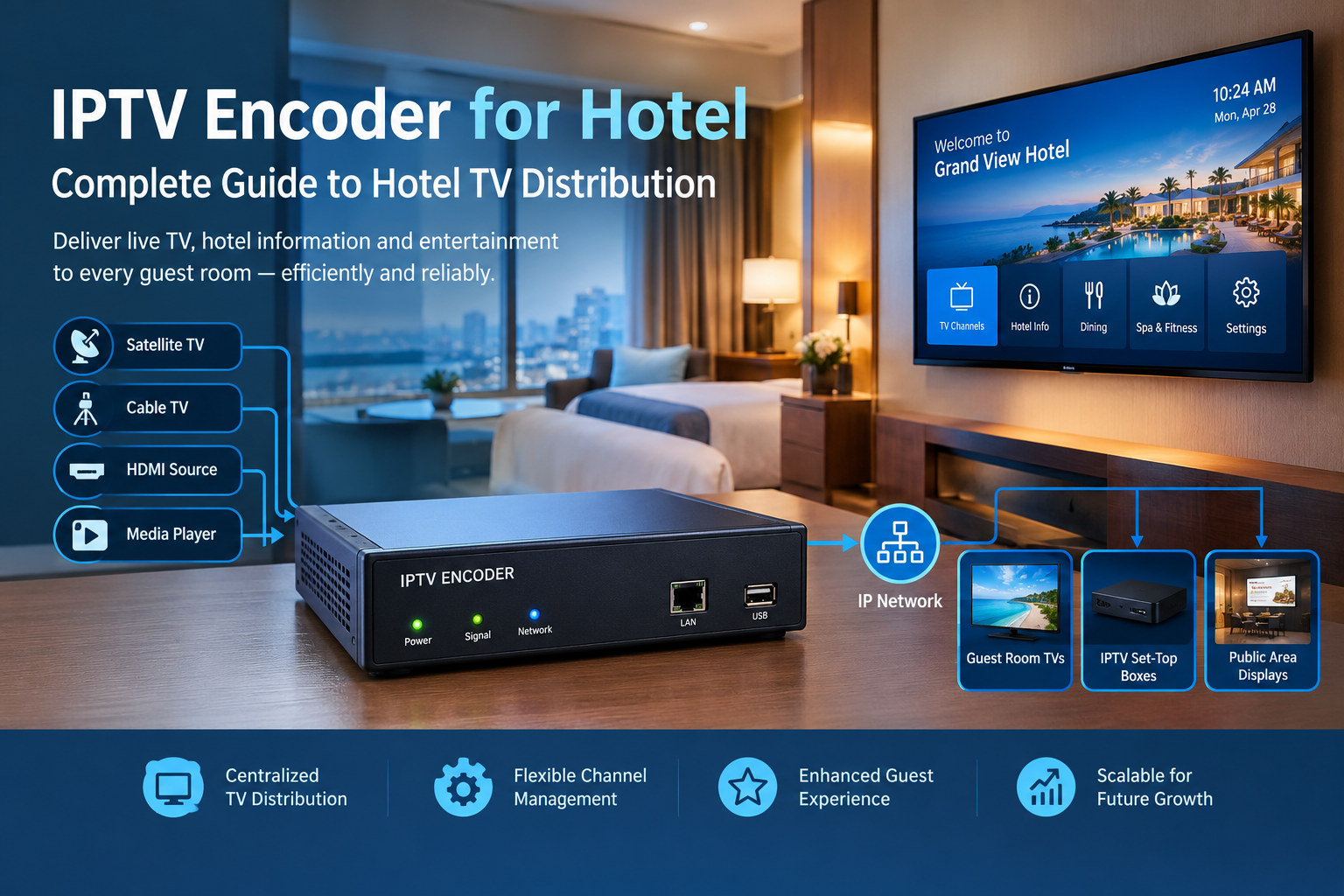
Quick summary: An IPTV encoder for hotel installations converts compatible television signals and video sources into digital streams that can be distributed over an IP network. Hotels use this technology to deliver TV channels, welcome screens, hotel information, and entertainment to guest rooms and common areas through a centralized system.
An IPTV encoder for hotel is an important component of modern hospitality television infrastructure. It helps hotel operators distribute authorized television content across compatible devices without relying exclusively on traditional coaxial distribution.
Whether you operate a boutique hotel, a business hotel, a luxury resort, or a large hospitality property, understanding how IPTV encoding works can help you choose a reliable, flexible, and scalable TV distribution solution.
What Is an IPTV Encoder for Hotel Systems?
An IPTV encoder for hotel systems is a hardware or software component that converts an audiovisual input into a digital stream suitable for transmission over an IP network. The input may come from a compatible satellite receiver, cable receiver, HDMI source, or another supported video device.
After encoding, the stream travels through the hotel’s network to compatible smart TVs, IPTV set-top boxes, or other supported playback devices. This allows television content to be distributed to guest rooms, restaurants, conference rooms, reception areas, and entertainment spaces.
A typical hotel IPTV installation may include:
- Television receivers and authorized video sources.
- IPTV encoders for converting compatible input signals.
- Managed Ethernet switches and network cabling.
- An IPTV middleware or channel management platform.
- Compatible televisions or IPTV set-top boxes.
- A content management system for hotel information and promotional displays.
The encoder handles signal conversion, while the remaining components manage network delivery, channel selection, playback, and interactive services.
Why Do Hotels Need an IPTV Encoder?
Hotel guests increasingly expect convenient access to television channels, clear picture quality, easy navigation, and useful information about hotel services. At the same time, hospitality businesses need infrastructure that is easy to manage and capable of supporting future expansion.
1. Centralized Television Distribution
A centralized IPTV system can distribute supported video sources to multiple guest rooms and common areas. Instead of maintaining a separate source for every television, the hotel can manage many channels from a central equipment location.
This approach can simplify equipment administration and make troubleshooting more efficient, particularly in larger properties.
2. Flexible Channel Management
With compatible IPTV middleware, hotels can organize channel lists and make appropriate content available in different areas. Guest rooms may receive an international channel lineup, while a restaurant or sports bar may use a different selection.
The available options depend on the IPTV platform, encoder capabilities, network design, and content distribution rights.
3. Hotel Information and Branding
A hotel IPTV platform can also turn guest-room televisions into information displays. Depending on the system, hotels may present:
- Welcome messages and hotel introductions.
- Restaurant menus and opening hours.
- Spa, gym, and room-service information.
- Conference schedules and event announcements.
- Promotional videos and available guest services.
- Emergency notifications and important hotel information.
These functions are generally managed by the IPTV middleware or content management platform rather than the encoder alone.
4. Easier System Expansion
A well-designed hotel IPTV system can accommodate additional channels, endpoints, and services as requirements change. Expansion may involve adding encoders, upgrading network equipment, or integrating additional playback devices.
Planning for future growth from the beginning can reduce the need for expensive infrastructure changes later.
How Does a Hotel IPTV Encoder Work?
Understanding the signal path helps hotel owners and technical teams identify the equipment required for a successful installation.
Step 1: Receive the Video Source
The system starts with an authorized television or video source. Common examples include satellite receivers, cable receivers, compatible HDMI devices, digital television receivers, and local media players.
The selected encoder must support the physical interface and video format provided by the source. An HDMI encoder, for example, cannot automatically accept every RF or broadcast input without additional compatible equipment.
Step 2: Encode the Video Signal
The encoder processes the incoming audiovisual signal and converts it into a supported digital stream. Depending on the model, it may support H.264/AVC, H.265/HEVC, and compatible audio formats.
Resolution, frame rate, compression settings, and bitrate affect picture quality, bandwidth consumption, and playback compatibility.
Step 3: Transmit the Stream Over an IP Network
The encoded stream travels through the hotel’s Ethernet infrastructure. Depending on the system, delivery may use multicast or unicast protocols.
Multicast is often efficient when many guest rooms watch the same live channel. However, switches and network equipment must support the required multicast configuration. Unicast may suit individual viewing sessions, but bandwidth demand can grow with the number of simultaneous streams.
Step 4: Manage Channels Through IPTV Middleware
IPTV middleware organizes available channels and provides the interface guests use to access content. Depending on the platform, it may also support electronic program information, welcome pages, device management, and interactive hotel services.
Confirm that the encoder’s output protocols and stream formats are compatible with the selected middleware.
Step 5: Display Content on Guest Televisions
Compatible smart TVs, IPTV applications, and set-top boxes receive and decode the streams for playback. Before a full installation, test the complete signal path with the television models and firmware used throughout the property.
Types of IPTV Encoders for Hotels
Different hotel environments require different encoding capabilities. The correct equipment depends on the number of video sources, input formats, channel requirements, and existing infrastructure.
HDMI IPTV Encoder
An HDMI IPTV encoder converts compatible HDMI video and audio signals into network streams. It can distribute supported content from television receivers, media players, presentation equipment, and other audiovisual sources.
Typical applications include:
- Distributing an authorized television receiver output.
- Sharing conference presentations across multiple displays.
- Delivering digital signage content.
- Distributing hotel promotional videos.
Check the supported input resolution, output protocols, audio formats, encoding standards, and HDMI content-protection requirements before purchasing an HDMI IPTV encoder.
Multi-Channel IPTV Encoder
A multi-channel IPTV encoder can process multiple input sources, depending on its design and processing capacity. This type of equipment may be appropriate for hotels that need to distribute a large selection of television channels from a centralized headend.
Compare the number of independent encoding channels, supported input combinations, maximum aggregate bitrate, management interface, and expansion options. The number of physical inputs does not always equal the number of simultaneously encoded streams.
Hardware IPTV Encoder
A hardware IPTV encoder is a dedicated appliance designed for video processing and IP distribution. It provides a defined set of supported interfaces and encoding capabilities.
When evaluating hardware, consider ventilation, power requirements, firmware updates, monitoring functions, mounting options, warranty coverage, and technical support.
Software-Based IPTV Encoding
Software encoding processes supported video sources using a computer or server. It can offer flexibility for certain media workflows, but performance depends on computing resources, supported input interfaces, software licensing, and configuration.
Compare the total cost of ownership, including hardware, software, maintenance, and support, rather than evaluating software licensing alone.
Broadcast and RF Headend Equipment
Some hotel installations receive television through satellite, cable, or terrestrial broadcast systems. These environments may require tuners, receivers, transport-stream processing, or specialized headend equipment before content can be distributed over IP.
Confirm that each component supports the source format and required output. An HDMI encoder is not a universal replacement for broadcast reception and processing equipment.
Key Features to Look for in an IPTV Encoder for Hotel
Choosing an encoder based only on price can lead to compatibility problems and unexpected installation costs. Evaluate the following technical requirements before selecting a device.
Video Resolution and Compression
Select an encoder that supports the resolutions required by your video sources and guest televisions. Full HD may be sufficient for many installations, while certain applications may require 4K support.
H.264 offers broad compatibility, while H.265 can provide improved compression efficiency in suitable conditions. The best option depends on decoder compatibility, image quality, processing requirements, and available bandwidth.
Input and Output Interfaces
Verify the exact interfaces supported by the equipment. Depending on the model, these may include HDMI, SDI, RF or tuner inputs, Ethernet ports, and supported IP streaming protocols.
Do not assume that every encoder supports all interfaces. Choose equipment based on the sources already installed at your property.
Multicast and Unicast Support
Multicast can reduce duplicated traffic when multiple televisions receive the same live channel over shared network links. A suitable deployment may require IGMP snooping, a multicast querier, and correctly configured network equipment.
Unicast can be appropriate for individual streams and specific applications. In that case, calculate the bandwidth needed for the expected number of concurrent viewing sessions.
Remote Management and Monitoring
A useful management interface allows technical staff to check device status, adjust supported encoding parameters, monitor streams, and investigate problems.
Depending on the model, features may include remote configuration, system logs, alerts, firmware management, and stream monitoring. Straightforward administration is particularly valuable for properties without a dedicated audiovisual team.
Reliability and Technical Support
Hotel television systems should be designed for consistent operation. Review the encoder’s operating temperature range, cooling requirements, warranty, firmware policy, and availability of replacement equipment.
For larger installations, consider whether the complete system needs backup power, spare encoders, redundant sources, or failover capabilities.
How to Calculate IPTV Bandwidth for a Hotel
Bandwidth planning is essential because a network that performs well during a small test may struggle when many guests watch television simultaneously.
The required capacity depends on the number of channels, average stream bitrate, delivery protocol, viewing patterns, and network topology.
Example: A 100-Room Hotel
Imagine a hotel distributing 30 live television channels, each encoded at an average bitrate of 5 Mbps.
Combined channel bitrate: 30 × 5 Mbps = 150 Mbps.
This represents the aggregate bitrate of the channel lineup, not the bandwidth required on every network link.
With multicast, a shared network link may carry each channel stream once, while downstream links carry the channels requested by devices beyond them.
With unicast, bandwidth can increase according to the number of simultaneous viewing sessions. For example, 40 simultaneous 5 Mbps streams passing through the same link would require approximately 200 Mbps for the video payload alone.
These are simplified calculations. Actual requirements depend on protocol overhead, network topology, other traffic, and viewing behavior.
Allow for Network Overhead and Future Growth
Avoid designing the network to operate continuously at its theoretical maximum capacity. Allow headroom for protocol overhead, peak usage, other hotel services, and future expansion.
Managed switches, network segmentation, traffic monitoring, and appropriate quality-of-service policies can help maintain predictable performance. Test the system under realistic concurrent viewing conditions before deployment.
IPTV Encoder for Hotel vs. Traditional Coaxial TV
Traditional coaxial television distribution remains useful in many properties, particularly where existing cabling is extensive and the current system meets guest requirements. IP-based distribution offers different advantages, but its suitability depends on the hotel’s infrastructure and objectives.
| Feature | IPTV Distribution | Coaxial TV Distribution |
|---|---|---|
| Infrastructure | Managed IP network | Coaxial distribution network |
| Content management | Can integrate with IPTV middleware | Depends on the headend and TV equipment |
| Expansion | May reuse suitable Ethernet infrastructure | May require RF distribution changes |
| Interactive services | Possible with compatible middleware and clients | Depends on the installed system |
| Troubleshooting | Network and stream diagnostics | RF signal and cabling diagnostics |
| Investment | Encoders, networking, licenses, and endpoints | Headend equipment, cabling, and televisions |
For some hotels, a hybrid design is the most practical choice. Existing coaxial infrastructure may continue to serve certain areas while IP equipment supports additional channels or services.
A professional site survey can help determine whether a complete migration, a partial upgrade, or continued use of the existing system offers the best value.
How to Choose the Right Hotel IPTV Encoding System
1. Determine the Number of Channels
List every source that needs to be distributed and identify the number of independent encoding channels required. Include potential additions such as international programming, sports content, and separate feeds for shared spaces.
2. Assess the Existing Infrastructure
Inspect network switches, cabling, rack space, power availability, and television models. Existing Ethernet infrastructure may be reusable, but its bandwidth, multicast support, and device compatibility must be verified.
3. Confirm IPTV Platform Compatibility
The encoder must work with the selected middleware, output protocols, and playback devices. Ask the supplier to demonstrate the complete signal path from the video source to an actual guest-room television.
4. Calculate the Total Cost of Ownership
Consider all the costs involved in deploying and maintaining the system, including:
- IPTV encoders and source receivers.
- Network switches and structured cabling.
- Middleware and software licenses.
- IPTV set-top boxes, where necessary.
- Installation, configuration, and staff training.
- Content rights and distribution permissions.
- Maintenance, monitoring, and technical support.
A lower-priced encoder may not provide the best value if it requires additional equipment or cannot integrate with the chosen IPTV platform.
5. Evaluate Vendor Support
Ask about documentation, warranty coverage, firmware updates, replacement equipment, and technical support response times.
For a hotel operating around the clock, dependable support can be just as important as the encoder’s specifications.
6. Run a Proof of Concept
Test a limited number of channels and televisions before rolling out the system across the property. Verify picture quality, audio synchronization, channel switching, network load, recovery after power loss, and compatibility with the management platform.
A successful proof of concept helps identify problems before they affect a large number of guest rooms.
Hotel IPTV Encoder Installation Checklist
Before Installation
- Document all television sources and required channels.
- Confirm the encoder’s input and output specifications.
- Assess network capacity and switch compatibility.
- Verify middleware and television compatibility.
- Confirm content distribution permissions.
- Plan equipment placement, ventilation, and power protection.
During Installation
- Label video sources, cables, and network ports.
- Configure encoding parameters according to the system design.
- Set appropriate IP addresses and network settings.
- Configure VLANs and multicast functions where required.
- Test every source and verify stream availability.
- Protect administrative interfaces with appropriate access controls.
After Installation
- Test representative guest rooms and shared areas.
- Verify channel lists and audio-video synchronization.
- Measure performance during concurrent viewing.
- Document configurations and recovery procedures.
- Train staff on basic troubleshooting.
- Schedule maintenance and firmware reviews.
For large properties, coordinate installation with the hotel’s IT team and an experienced audiovisual integrator.
Common Problems With Hotel IPTV Encoders and How to Solve Them
IPTV Channels Keep Buffering
Buffering may result from insufficient bandwidth, packet loss, overloaded equipment, or incorrect multicast configuration.
Check the stream at the encoder output, review network utilization, and inspect switch counters. If only certain rooms are affected, investigate their network connections and playback devices before replacing the encoder.
No Picture on the Television
A missing picture can result from an unsupported resolution, incompatible codec, incorrect source selection, or HDMI content-protection restrictions.
Confirm that the source is active, verify the encoder’s input compatibility, inspect the output stream, and check whether the receiving device supports the selected encoding parameters.
Audio and Video Are Out of Sync
Synchronization problems may originate in the source, encoder settings, intermediate processing equipment, or decoder.
Test the source directly where possible, inspect the encoded output, and verify that the audio format and synchronization settings are compatible with the complete playback chain.
Some Channels Work While Others Fail
Different channels may use different sources, encoding settings, or network paths. Compare a working channel with a failing one and check the input signal, encoder status, stream parameters, and receiver compatibility.
For multicast installations, verify that subscriptions and multicast forwarding operate as expected.
The System Becomes Unstable During Peak Hours
Problems that occur only during busy periods may indicate network congestion or insufficient capacity.
Measure traffic during peak usage, review switch utilization, and confirm that the network has adequate headroom. If IPTV shares infrastructure with guest Wi-Fi and other hotel services, review segmentation and traffic policies with the network administrator.
Security Best Practices for Hotel IPTV Systems
Hotel IPTV equipment should be managed as part of the property’s wider IT environment. Unprotected management interfaces and poorly segmented networks can introduce unnecessary security risks.
Recommended practices include:
- Change default administrative credentials.
- Restrict management access to authorized systems and personnel.
- Use secure management protocols where supported.
- Apply firmware updates through a tested maintenance process.
- Separate IPTV devices from guest Wi-Fi and sensitive business systems.
- Disable unnecessary services and interfaces.
- Maintain configuration backups and recovery procedures.
- Monitor device availability and unusual network activity.
The appropriate security architecture depends on the equipment and network design. Follow the manufacturer’s documentation and the hotel’s IT security policies.
Content Licensing and Compliance
Technical compatibility does not automatically grant permission to redistribute television programming throughout a hotel.
Commercial hospitality use may be subject to broadcaster agreements, content-provider restrictions, regional regulations, and separate licensing arrangements.
Before distributing channels to guest rooms or public areas, confirm that the hotel has the necessary rights for its intended use. Also review applicable requirements for protected HDMI sources, encrypted broadcasts, recording restrictions, and distribution across multiple properties.
Working with authorized providers and reputable system integrators can help reduce legal and operational risks.
Which Hotels Benefit Most From IPTV Encoding?
Boutique Hotels
Boutique hotels may benefit from centralized television distribution and branded welcome screens without deploying an unnecessarily complex entertainment infrastructure.
The best configuration depends on room count, guest expectations, and the services the property intends to provide.
Business Hotels
Business hotels often need reliable guest-room television alongside conference presentations, meeting-room displays, and event information.
An IP-based video architecture can support these requirements when the sources, endpoints, and management systems are compatible.
Resorts and Large Hotels
Large hotels and resorts may require different channel lineups across guest rooms, restaurants, bars, and recreational facilities.
A scalable encoding and distribution system can simplify centralized administration while allowing additional endpoints to be introduced as the property grows.
Healthcare and Extended-Stay Properties
Some healthcare facilities and extended-stay properties use similar centralized television distribution technology. However, they may have additional privacy, accessibility, and compliance requirements that should be included in the system design.
Frequently Asked Questions About IPTV Encoders for Hotels
What is an IPTV encoder for hotel TV?
An IPTV encoder for hotel TV converts compatible video and audio inputs into digital streams that can be delivered over an IP network to supported televisions, set-top boxes, and IPTV clients.
How many channels can one hotel IPTV encoder support?
The number depends on the encoder model, input interfaces, processing capacity, and configuration. A single-channel device may process one source, while a multi-channel encoder may handle several. Check the manufacturer’s simultaneous-channel specifications before purchasing.
Does an IPTV encoder require an internet connection?
Not necessarily. Television streams can travel over the hotel’s internal local area network without using the public internet. Internet connectivity may be needed for particular cloud management features, online services, or software updates.
Can an IPTV encoder work with existing hotel TVs?
Yes, provided the televisions support the selected IPTV application or stream format. Otherwise, compatible IPTV set-top boxes or other client devices may be required. Test compatibility before purchasing equipment for the entire property.
Is H.264 or H.265 better for hotel IPTV?
H.264 offers broad compatibility, while H.265 can provide improved compression efficiency in suitable conditions. The best choice depends on encoder and decoder support, image-quality requirements, and available network bandwidth.
Is multicast necessary for hotel IPTV?
No. IPTV systems can use multicast or unicast. Multicast is often efficient for live channels viewed by many guests, while unicast can suit individual streams and certain applications. The appropriate choice depends on the system architecture.
Can an IPTV encoder distribute 4K content?
Some encoders support 4K, but not all. Verify input and output resolution, frame rate, codec, bitrate, HDMI protection requirements, and receiving-device compatibility.
How much does a hotel IPTV encoder cost?
Pricing depends on channel capacity, interfaces, encoding features, management functions, and manufacturer. The total installation cost may also include source receivers, network equipment, middleware, playback devices, licensing, and installation.
Can an IPTV encoder display hotel welcome messages?
An encoder can carry video from a compatible welcome-message source. Personalized pages, interactive menus, and hotel service information are usually managed through the IPTV middleware or content management platform.
What is the difference between an IPTV encoder and IPTV middleware?
The encoder converts video sources into digital streams. Middleware manages aspects of the IPTV service, including channel organization, user interfaces, device integration, and supported interactive features. Both components must be compatible with the overall system.
Conclusion: Choose the Right IPTV Encoder for Your Hotel
An IPTV encoder for hotel installations can be an important part of a modern television distribution system. It helps hospitality businesses distribute supported video content centrally and build a more flexible audiovisual infrastructure.
The right solution depends on channel requirements, input sources, network capacity, video quality, television compatibility, management features, content licensing, and long-term technical support.
Rather than choosing equipment based on specifications alone, evaluate the complete system. Confirm compatibility with your sources and IPTV platform, test the network under realistic conditions, and plan for future expansion.
Ready to upgrade your hotel’s TV distribution system? Review your current infrastructure, identify the channels and features your guests need, and contact a qualified IPTV equipment supplier or system integrator for a solution tailored to your property.
Have questions about selecting an IPTV encoder for hotel deployment? Contact our team to discuss your requirements, or explore our related guides to learn more about IPTV encoding and distribution.


